

Medicine
Ending The Extortion
If you only ate food sold at a red-logo pharmacy, you would get a terminal illness.
That is no accident - they want to sell you drugs with higher profit-margins than the food. Buying that food will make you a customer of those drugs.
The medical & pharmaceutical industries holds massive influence in Washington, and as a result, people - patients, and more recently, executives - are dying.
Demand for certain drugs, and their price:
Although we, the Production Party, have no politicians in office yet, we are already drafting a bill which will mathematically balance the price of a drug with based on demand.
Consider two examples:
1. Insulin / Cancer medications - the buy or die category
These drugs are not optional for those who need them. Companies, ranging from the inventors and manufacturers (Bayer, Pfizer) and pharmacies (CVS, Walgreens) collaborate in price-fixing to maximize their profits. They hire consultants, cherrypick candidates from the FDA/CDC and across corporate lines, and build analytics systems just to sell you that drug at the highest possible price. Insurance companies and Pharmacy Benefit Managers (PBM's) merely facilitate this process.
Since they know patients will pay anything to survive, these products have In-elastic Demand, meaning that if the price goes up, the same number of people will buy it, until the patients have no money left or die.
2. Ozempic / Adderall - the buy it if you want it category
Some drugs are not necessary for survival. They are effectively optional for those who buy them, and sometimes cause patients more harm than good. Some can be replaced by literally nothing (just stop eating so much, buy less food instead of more drugs, idiot). In economic terms, we say these drugs have Elastic Demand - meaning if the price goes up, less people will buy it.
Greed must be removed from the equation of healthcare.
Below we describe how:
With the data available in the modern world, we can create an equation, like this, as part of the proposed bill. Our rough, very simplified draft looks something like this:

Where...
Inelasticity is a decimal between 0 and 1
$Cost is a dollar amount, how much it costs to make the treatment
$Price is a dollar amount, how much the patient pays at the pharmacy counter
Let's plug in some numbers for the examples described above:
Example #1 - Buy or Die drugs, more controlled over pricing, high inelasticity = 0.99
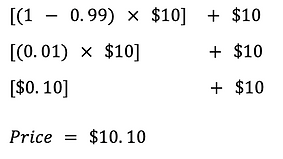
This means that as a disease becomes more lethal, the treatment becomes cheaper.
This will improve patient outcomes, as well as the reputations of executives (less assassinations).
Example #2 - Buy if you Decide, more free market pricing, low inelasticity = 0.1

This means that pharma companies can still make a 90% profit margin on drugs which have elastic demand; so for drugs which make you lose weight, not those which treat cancer, companies can still sell them and make decent money.
Addiction is partially factored into this equation as it is. If a drug is more addictive, its inelasticity value goes up, meaning the price goes up as well; hopefully meaning less people will buy drugs like Xanax and Opioids.
We are considering adding more factors for drugs which are psychoactive / addictive. Factors may include receptor-specific binding data, for example, dopaminergic EC50
Incentivizing cures at the team/personal level:
You have likely already heard something along the lines of "a patient cured is a customer lost." People deserve to be rewarded for excellent work - if you cure cancer, you do deserve to be a billionaire. However, this absolutely cannot come from taking a terminally ill person's savings.
We'd like your help in finalizing this incentives program. Applications are open.
Want to help us write this bill or modify the equation? Reach out, and seriously consider running for office.
Additional factors to our medical policies & bills may include:
- Taxes/fines on pharma companies which abused consumers, such as during the opioid epidemic, to fund med-school & residency scholarships & rehabilitation centers.
- Price factors based on DX codes & diagnosis lethality / life expectancy.
- Fixed time-periods for the "$Cost" factor, so that companies don't abuse this factor for profit
- Drugs below 0.2 Inelasticity can be priced at whatever price, so they can still make money off rich people
- Benefits for companies & drugs yielding higher Quality-Adjusted Life Years (QALY)
- Massive Cash Prize / Rewarded grant money for curing diseases (Cure cancer = win $2b, untaxed)
Let’s Work Together
Get in touch so we can start working together.


